

 (Only
(Only  Loading...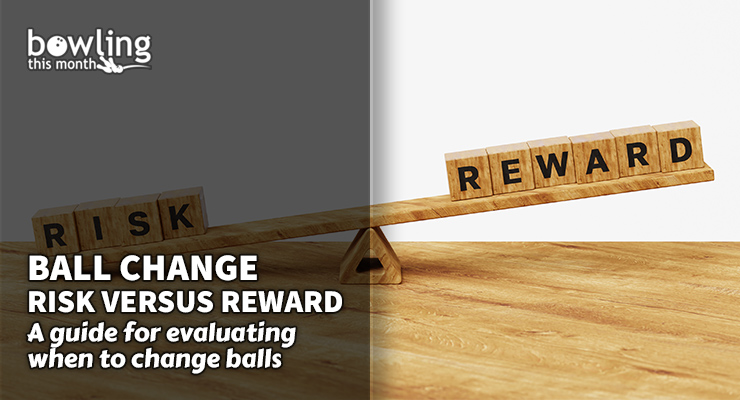
Article Contents
- 1. Evaluating when to change balls
- 2. Physical adjustments
- 2.1. What is in my toolbox?
- 2.2. What is available?
- 2.3. Minimizing risk
- 3. How well do you know your equipment?
- 3.1. Confident ball changes
- 3.2. Understanding your progression
- 4. How is your bag set up?
- 5. Scoring pace
- 5.1. The ball change math
- 5.2. When to risk it all
- 6. Final thoughts
Note: This article is only available to Bowling This Month subscribers.
In my recent article, When Striking Shouldn’t Be the Focus, I referred to ball changes as high-risk adjustments. After that article was published, I received a few private messages questioning why I said that. Do I really consider them high-risk? If so, why do I often suggest people make ball changes more frequently?
Granted, it’s a bit of both of these being true. I consider ball changes to be higher-risk adjustments than physical adjustments, such as release adjustments. But I also suggest that bowlers change balls as soon as and as often as possible, especially in league play. I’ll get to my reasoning later, but the messages I received on this topic inspired this article.
When should you change balls? When is that risk tolerable, and when should you play it safe and stick to the ball you’ve got in your hand, even if you know your ball reaction isn’t perfect? These are tough questions faced by every bowler and coach.
This is all about evaluating risk. Let’s dive in.
Evaluating when to change balls
There are several factors to consider when deciding to change balls, and they include the following:
- What are the physical adjustments you have already made and can still make?
- How well do you know your equipment?
- What is the relative “closeness” of the next ball in your progression?
- What is the scoring pace/difficulty of the environment?
This is almost universally the checklist, whether you are a beginner or an elite-level bowler. Notice that I didn’t include anything about the pin action or your current scoring.
For this article, we’re going to operate under the assumption that you know your ball reaction isn’t quite right. You’re not considering whether to adjust; instead, you’re considering whether the adjustment should be a physical one or an equipment change.
Physical adjustments
I vividly remember an example from my own bowling career of opting for a physical adjustment over a ball change.
I was 24 years old, competing at the Canadian Team Trials. It was the sixth game of the block, and I’d just moved to a new pair. My first two frames were a weak 10 and a pocket 7/10. The head coach for Team Canada at the time ...
Already a premium member? Click here to log in.